
💡 本文重點導覽
- BMI calculator Singapore: how do I work out my BMI?
- What is a healthy BMI in Singapore?
- Why does Singapore use lower BMI cut-offs for Asians?
- Why do some Singapore pages say obesity starts at a BMI of 30?
- What healthy weight range matches my height?
By 胖胖 / ResetWith · Updated 23 October 2026
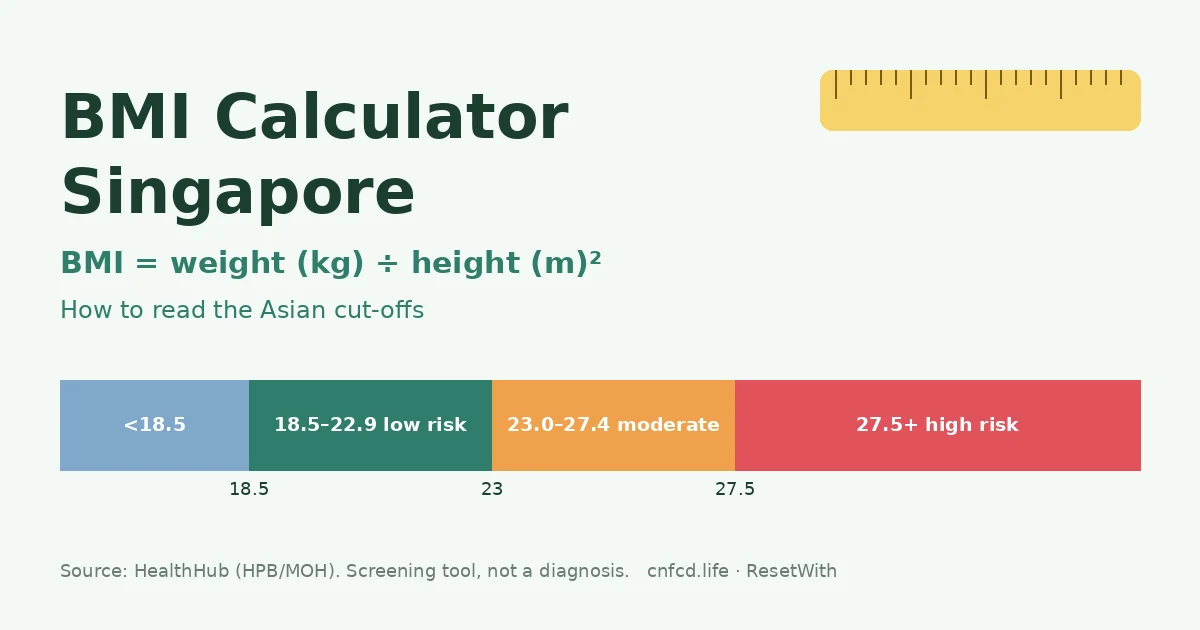
Any BMI calculator Singapore residents use works the same way: divide your weight in kilograms by your height in metres squared, then compare the result with the Asian cut-offs used by HealthHub: 18.5 to 22.9 is low risk, 23.0 to 27.4 is moderate risk, and 27.5 or above is high risk. These are lower than the international 25 and 30 because Asians face higher health risk at a lower BMI. BMI is a screening tool, not a diagnosis, so check your waist as well.
I once weighed over 100 kg and lost 34 kg in four months. That is my own experience, not a promise or a target; every body is different, and my pace was faster than the 0.5 to 1 kg a week guidance below.
BMI calculator Singapore: how do I work out my BMI?
BMI is your weight in kilograms divided by your height in metres multiplied by itself.
BMI (body mass index) compares weight with height. HealthHub says it screens for weight categories that may raise health risk, but does not diagnose your body fatness or health.
- Weigh yourself in kilograms.
- Convert your height to metres (160 cm = 1.60 m) and multiply it by itself (1.60 × 1.60 = 2.56).
- Divide your weight by that number.
Worked example (a hypothetical person, not a client): 62 kg ÷ 2.56 = BMI 24.2.
HPB’s free BMI and calorie calculator does the maths for you.
What is a healthy BMI in Singapore?
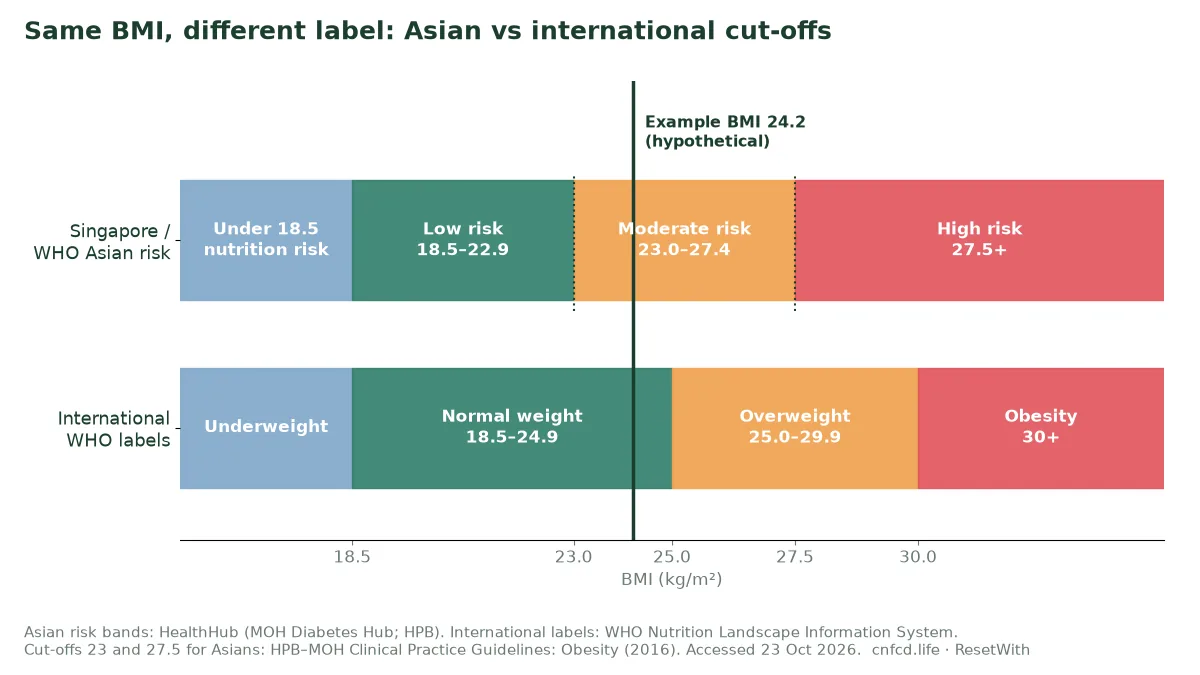
A healthy BMI in Singapore is 18.5 to 22.9; from 23.0, HealthHub classes adults as moderate risk, and from 27.5 as high risk.
| BMI (kg/m²) | Singapore / WHO Asian risk band | International WHO label |
|---|---|---|
| Below 18.5 | Risk of nutritional deficiency and osteoporosis | Underweight |
| 18.5 – 22.9 | Low risk (healthy range) | Normal weight |
| 23.0 – 24.9 | Moderate risk | Normal weight |
| 25.0 – 27.4 | Moderate risk | Overweight |
| 27.5 – 29.9 | High risk | Overweight |
| 30 and above | High risk | Obesity |
Asian risk bands: HealthHub Diabetes Hub (MOH). International labels: WHO. Rows split to line up both systems.
HealthHub links a high BMI with type 2 diabetes, high blood pressure, heart disease, stroke, some cancers, and bone and joint disorders.
Why does Singapore use lower BMI cut-offs for Asians?
Singapore uses lower cut-offs because, as HealthHub notes, Singaporeans have been found to be at risk of cardiovascular disease and diabetes from a BMI of 23, below the international overweight line of 25.
A 2004 WHO expert consultation in The Lancet found that many Asians are at high risk below the international overweight cut-off of 25; the risk threshold varied from 22 to 25 across Asian populations. WHO kept 25 and 30 as international labels and proposed public health action points at 23.0, 27.5, 32.5 and 37.5. The HPB–MOH Clinical Practice Guidelines on obesity recommend 23 and 27.5 for Asians.
So the hypothetical BMI of 24.2 above is “normal” on an international chart but moderate risk in Singapore. My guide to the thin-fat phenotype explains why lean-looking East Asians can carry hidden risk.
Why do some Singapore pages say obesity starts at a BMI of 30?
Some pages label “obese” at 30 for counting purposes, while the 23 and 27.5 cut-offs describe health risk.
HealthHub’s weight management page uses 23.0 to 29.9 for overweight and 30 for obese. MOH’s national health survey tracks both: obesity (BMI 30 and above) rose from 10.5% in 2019–2020 to 12.7% in 2023–2024, while 22.8% of residents aged 18 to 74 had a BMI of 27.5 or above. The labels differ, but both systems flag 23 as the point to start paying attention.
What healthy weight range matches my height?
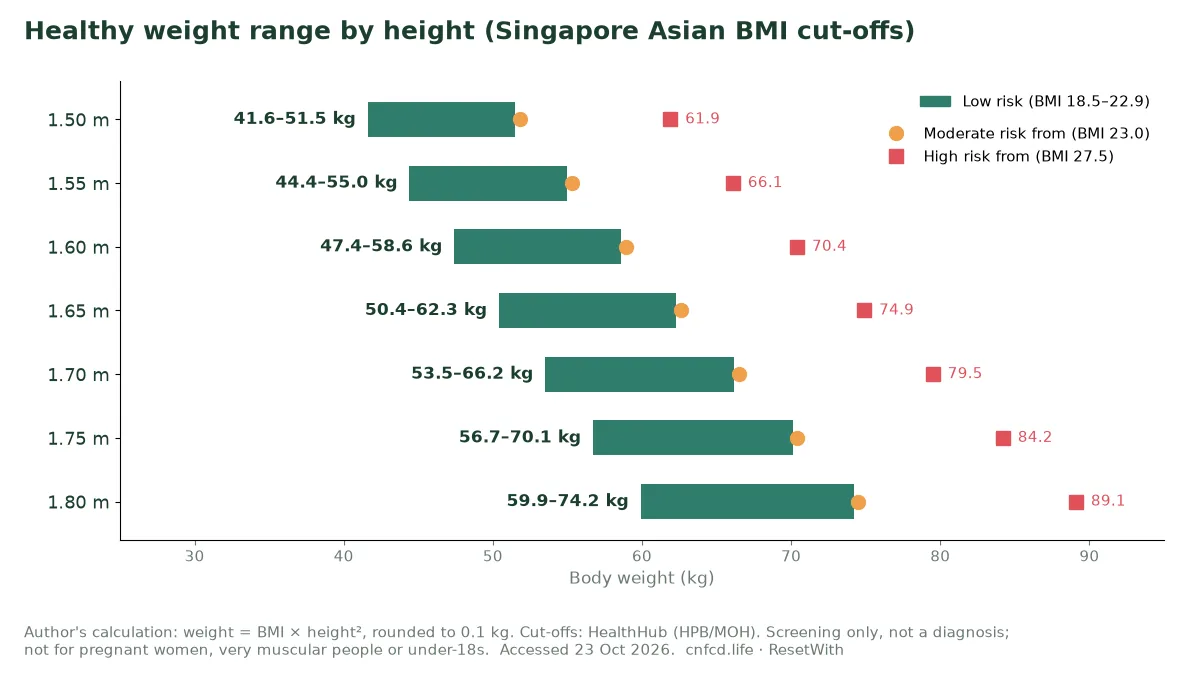
For your height, the healthy range is the weight that gives a BMI of 18.5 to 22.9.
| Height | Low-risk weight (BMI 18.5–22.9) | Moderate risk from (BMI 23.0) | High risk from (BMI 27.5) |
|---|---|---|---|
| 1.50 m | 41.6 – 51.5 kg | 51.8 kg | 61.9 kg |
| 1.55 m | 44.4 – 55.0 kg | 55.3 kg | 66.1 kg |
| 1.60 m | 47.4 – 58.6 kg | 58.9 kg | 70.4 kg |
| 1.65 m | 50.4 – 62.3 kg | 62.6 kg | 74.9 kg |
| 1.70 m | 53.5 – 66.2 kg | 66.5 kg | 79.5 kg |
| 1.75 m | 56.7 – 70.1 kg | 70.4 kg | 84.2 kg |
| 1.80 m | 59.9 – 74.2 kg | 74.5 kg | 89.1 kg |
My own calculation: BMI × height², rounded to 0.1 kg, using HealthHub’s Asian cut-offs.
Is BMI accurate, and should I check my waist too?
BMI is a useful first check but can mislead, so HealthHub suggests watching your waist as well.
HealthHub says BMI is less accurate for very muscular people, people with sarcopenia (age-related muscle loss), children and pregnant women. The Singapore Heart Foundation’s BMI calculator adds that its ranges should not be used for the elderly or anyone under 18.
Waist circumference reflects fat around your middle. HealthHub says a waist above 90 cm for Asian men or above 80 cm for Asian women implies abdominal obesity. Measure close to the skin, midway between your lowest rib and the top of your hip bone, as you breathe out. My guides on waist circumference and hidden obesity at a normal weight explain why this matters.
My BMI is 23 or above. What should I do next?
Start with a modest goal: HealthHub suggests losing 10 to 15% of your weight over six months at 0.5 to 1 kg a week, and Singapore’s clinical guidelines count an initial 5 to 10% as a worthwhile first step.
- HealthHub’s healthy weight guide says that with a BMI of 23 or above, losing 10 to 15% of your current weight over 6 months at 0.5 to 1 kg a week is a healthy target.
- The HPB–MOH guidelines set an initial goal of 5 to 10% over six months.
- HealthHub’s Diabetes Hub says even losing 5 to 10% can help lower blood sugar, blood pressure and cholesterol.
For a hypothetical 80 kg adult, 5% is 4 kg and 10% is 8 kg. Small, steady changes add up.
If you have diabetes, high blood pressure or another condition, are pregnant, or take medication, speak to your doctor before changing how you eat or exercise. Do not change your medication on your own. Weight-loss drugs and injections are a decision to make with your doctor.
Frequently asked questions
What is a normal BMI for Asians in Singapore?
18.5 to 22.9. HealthHub classes 23.0 to 27.4 as moderate risk and 27.5 or above as high risk for health problems such as heart disease and diabetes.
Is a BMI of 24 overweight in Singapore?
Yes. HealthHub’s weight management page labels 23.0 to 29.9 as overweight for Asians, and its risk scale puts 24 at moderate risk. On the international WHO scale, 24 is still normal weight.
Does the adult BMI range apply to children?
No. HealthHub says the adult ranges do not apply below 18; schools use BMI-for-age norms instead, per the HPB–MOH obesity guidelines.
What waist size is too big?
HealthHub says a waist above 90 cm for Asian men or above 80 cm for Asian women implies abdominal obesity.
If this made sense and you want to actually reset your weight and metabolism —
but you’re not sure where to start — you don’t have to figure it out alone.
Tell me your situation and I’ll help you find the right first step.
Free, no pressure
This article is general health education, not medical advice or a diagnosis. If you have a medical condition, take medication, or are considering weight-loss drugs, please speak with your doctor.
简中摘要
BMI 怎么算?用体重(公斤)除以身高(米)的平方。新加坡 HealthHub 采用亚洲标准:18.5 至 22.9 为低风险(健康范围),23.0 至 27.4 为中度风险,27.5 以上为高风险,比国际标准的 25 和 30 更低,因为亚洲人在较低 BMI 时就有较高的糖尿病和心脏病风险。有些页面以 30 作为”肥胖”的统计定义;卫生部调查显示,2023–2024 年 18 至 74 岁居民中 12.7% 的 BMI 达 30 以上,22.8% 达 27.5 以上。BMI 只是筛查工具,不是诊断;肌肉发达者、肌少症患者、孕妇和 18 岁以下者准确度较低或不适用。也请量腰围:亚洲男性超过 90 厘米、女性超过 80 厘米属腹部肥胖。BMI 23 以上者,HealthHub 建议 6 个月内减 10% 至 15%,每周不超过 0.5 至 1 公斤。有慢性病或在服药者,请先咨询医生。
References
- HealthHub (HPB). Weight, BMI and health problems (last reviewed 10 May 2023).
- HealthHub Diabetes Hub (MOH). Managing your weight: WHO Asian classification of BMI risk category.
- HealthHub (HPB). BMI and calorie calculator.
- HealthHub (Pharmaceutical Society of Singapore). Weight management (last reviewed 23 January 2025).
- HealthHub (HPB). How to eat right to feel right (last reviewed 15 November 2022).
- HealthHub (HPB). Do you know all there is to know about your belly fat? (last reviewed 15 November 2022).
- HealthHub (HPB). What is a healthy weight? (last reviewed 6 January 2026).
- Singapore Heart Foundation. BMI calculator.
- Ministry of Health Singapore. National Population Health Survey 2024 shows Singaporeans are adopting healthier lifestyles, but rising obesity is a concern (17 October 2025).
- WHO Expert Consultation. Appropriate body-mass index for Asian populations and its implications for policy and intervention strategies. Lancet. 2004;363(9403):157-63. PubMed 14726171.
- Lee YS, et al. Health Promotion Board–Ministry of Health Clinical Practice Guidelines: Obesity. Singapore Med J. 2016;57(6):292-300. PubMed 27353244; full text, PMC4971447.
- World Health Organization. Nutrition Landscape Information System: body mass index (BMI) indicator definitions.
ResetWith 顧問團隊
CNFCD® 個人化代謝健康系統 | 微康公司
本文由 ResetWith 顧問團隊根據科學文獻與超過 16 萬筆台灣真實個案數據撰寫。所有內容以 CNFCD® 方法論為基礎,供健康參考使用。
發布:2026年10月26日 最後更新:2026年10月26日
Recommended next reads
Author, Review, and Health Content Note
Publisher: ResetWith consulting team. Principal consultant: Pangpang / Sean Shih. Last updated: 2026-10-26.
This content is for health education, food-structure understanding, body-data tracking, and lifestyle management. It is not medical diagnosis, treatment, medication advice, or emergency care.
Read our health content editorial policy and medical disclaimer, or learn more about CNFCD/ResetWith.