
💡 本文重點導覽
- How many calories do I need a day in Singapore?
- How many calories do I need a day to lose weight?
- How do I calculate my BMR and TDEE?
- Why does my weight loss slow down on the same calories?
- How do hawker meals fit into a daily calorie budget?
By 胖胖 / ResetWith · Updated 22 October 2026
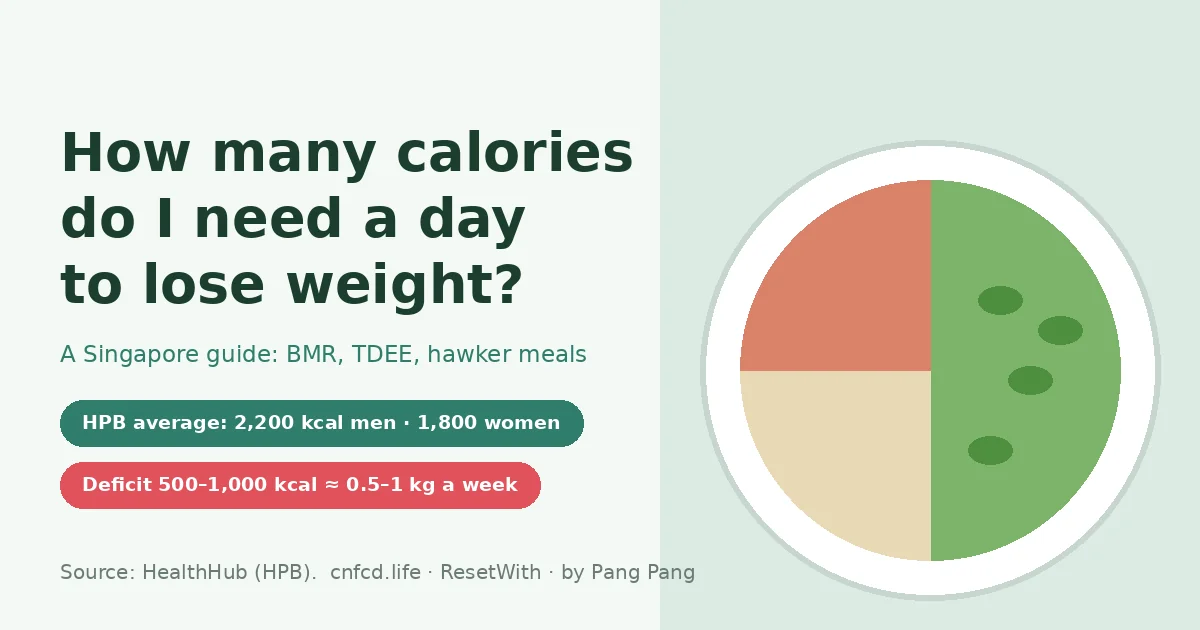
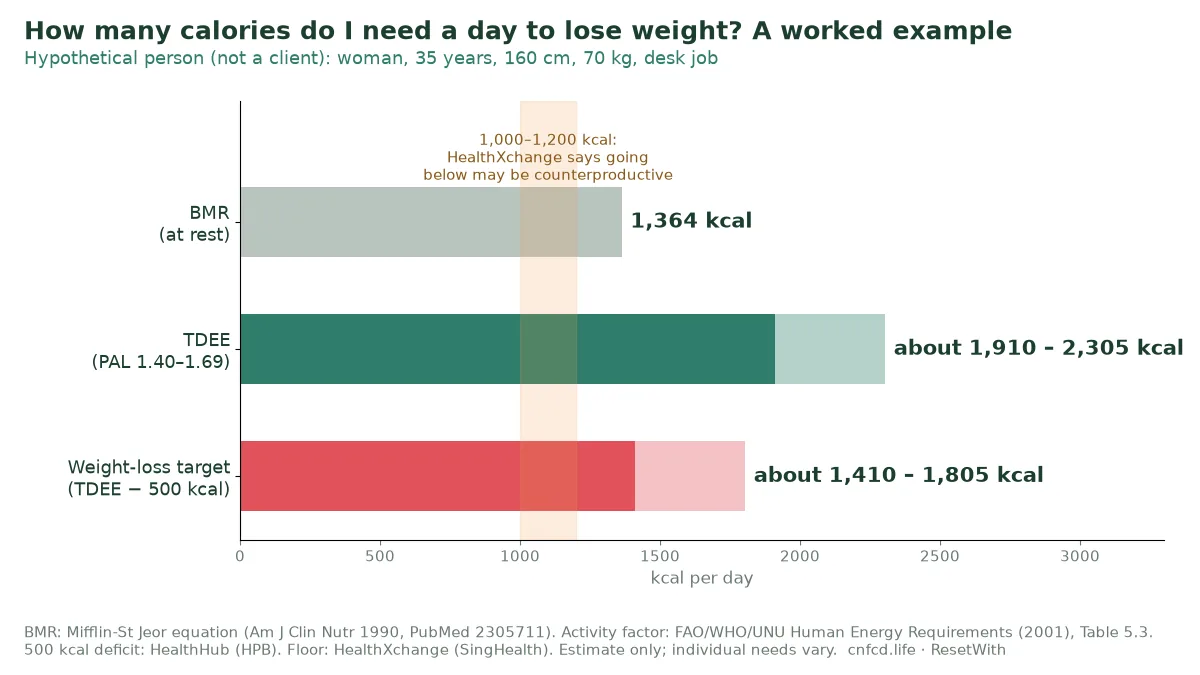
How many calories do I need a day to lose weight? For most adults, about 500 to 1,000 kcal less than the body burns each day, which HealthHub says leads to a loss of 0.5 to 1 kg a week. HPB’s average daily intake is 2,200 kcal for men and 1,800 kcal for women, but your own number depends on your age, sex, height, weight and activity level. SingHealth’s HealthXchange warns that going below 1,000 to 1,200 kcal a day may be counterproductive.
I once weighed over 100 kg and lost 34 kg in four months. That is my own experience, not a promise; every body is different.
How many calories do I need a day in Singapore?
The average recommended daily calorie intake in Singapore is 2,200 kcal for men and 1,800 kcal for women, according to HealthHub.
These figures are based on the average weight and activity of Singaporean men and women; a personal figure must account for age, sex, height, weight and activity. HealthXchange gives two examples from HPB’s calculator: a 75 kg man aged 30 to 49 with light activity needs about 2,000 kcal a day, and a 60 kg woman of similar age and activity about 1,600 kcal.
These are maintenance figures, not weight-loss targets.
How many calories do I need a day to lose weight?
To lose weight, eat about 500 to 1,000 kcal a day less than you burn; HealthHub says this deficit allows a loss of 0.5 to 1 kg a week.
A calorie deficit means taking in fewer calories than your body uses. HealthHub’s diet vs exercise guide gives the 500 to 1,000 kcal range, and its weight management page says healthy weight loss should be no more than 0.5 to 1 kg a week. Losing weight too quickly can lead to dehydration, muscle loss, a slower metabolism and poor nutrition.
| Starting point (source) | Daily intake | With a 500 kcal deficit |
|---|---|---|
| HPB average, men (HealthHub) | 2,200 kcal | about 1,700 kcal |
| HPB average, women (HealthHub) | 1,800 kcal | about 1,300 kcal |
| 75 kg man, light activity (HPB calculator via HealthXchange) | about 2,000 kcal | about 1,500 kcal |
| 60 kg woman, light activity (HPB calculator via HealthXchange) | about 1,600 kcal | about 1,100 kcal (within the 1,000–1,200 range) |
The last column is my own subtraction, not an official target. HealthXchange says eating under 1,000 to 1,200 kcal a day may be counterproductive.
How do I calculate my BMR and TDEE?
Multiply your estimated BMR by an activity factor to get your TDEE, then subtract about 500 kcal for a gentle deficit.
BMR (basal metabolic rate) is the energy your body uses at rest. TDEE (total daily energy expenditure) is the total calories your body burns in 24 hours, including physical activity, as HealthHub defines it.
- Estimate BMR. The Mifflin-St Jeor equation (1990, 498 adults) is: women = 10 × weight (kg) + 6.25 × height (cm) − 5 × age − 161; men = same, but + 5 instead of − 161. It estimates resting energy expenditure, which this guide treats as BMR.
- Multiply by your activity level. FAO/WHO/UNU classes a sedentary or light-activity lifestyle as 1.40 to 1.69, active as 1.70 to 1.99 and vigorous as 2.00 to 2.40.
- Subtract about 500 kcal, staying above the 1,000 to 1,200 kcal floor.
Worked example (a hypothetical person, not a client): a 35-year-old woman, 160 cm, 70 kg, desk job. BMR = 700 + 1,000 − 175 − 161 = 1,364 kcal. TDEE = 1,364 × 1.40 to 1.69, about 1,910 to 2,305 kcal. Target = about 1,410 to 1,805 kcal a day.
Every formula is an estimate. HPB’s free BMI and calorie calculator and the Healthy 365 app’s Meal Log of local dishes are easier starting points.
Why does my weight loss slow down on the same calories?
Your body burns less as you get lighter, so the same intake creates a smaller deficit over time.
A 2011 Lancet modelling study led by a US National Institutes of Health researcher says the popular “3,500 kcal per pound” rule ignores these adaptations. Its rule of thumb for an average overweight adult: each permanent change of 100 kJ (about 24 kcal) a day leads to an eventual weight change of about 1 kg, with about half reached in a year and 95% in about three years. So expect progress to slow, and recheck your numbers as you lose weight. My weight-loss plateau guide goes deeper.
How do hawker meals fit into a daily calorie budget?
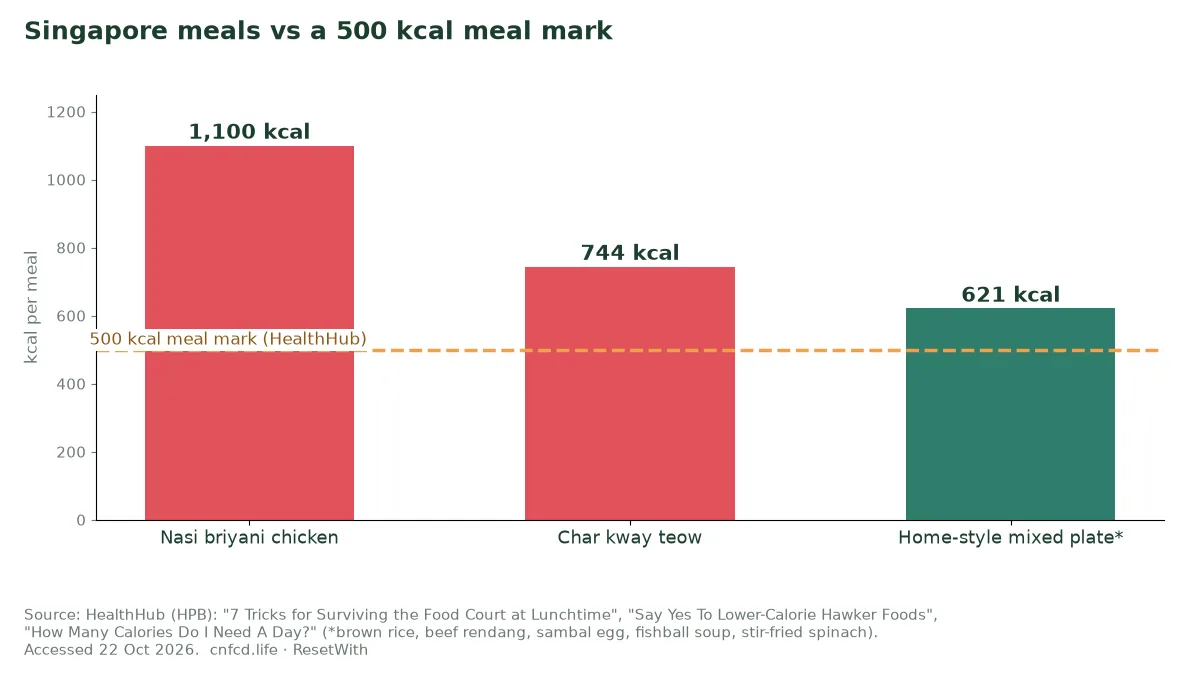
Many hawker meals use up a third or more of a weight-loss budget, so choose dishes near HealthHub’s 500-kcal limit.
HealthHub figures:
- a serving of char kway teow has 744 kcal and 38 g of fat;
- a nasi briyani chicken can reach 1,100 kcal, and most meals eaten out are about 700 to 800 kcal;
- a home-style plate of brown rice, beef rendang, sambal egg, fishball soup and stir-fried spinach adds up to 621 kcal.
HealthHub’s lower-calorie picks include thunder tea rice, fish slice bee hoon soup and yong tau foo with non-fried items. It also suggests steamed or braised over deep-fried, less oil, and no gravy or curry on the rice. More ordering ideas are in my guide to eating out while losing fat.
Is counting calories enough to lose weight?
Counting calories is not enough on its own: HealthHub calls the right number a good first step, but says not all calories are equal.
HealthHub recommends My Healthy Plate (half fruit and vegetables, a quarter wholegrains, a quarter lean meat and others), notes that 1 g of fat has 9 kcal while protein or carbohydrate has 4, and suggests at least 150 to 300 minutes of moderate-intensity aerobic activity a week. Enough protein helps you keep muscle while eating less; see my protein and fat loss guide.
If you have diabetes or kidney disease, are pregnant, or take medication, ask your doctor or dietitian before cutting calories. Do not change your medication on your own. Weight-loss drugs and injections are a decision to make with your doctor.
Frequently asked questions
How many calories do I need a day to lose weight?
About 500 to 1,000 kcal less than you burn each day; HealthHub says this leads to a loss of 0.5 to 1 kg a week. HPB’s averages are 2,200 kcal for men and 1,800 kcal for women, so your own number may differ.
Is 1,200 calories a day too low?
HealthXchange says eating under 1,000 to 1,200 kcal a day may be counterproductive, because you can lose more muscle along with fat. Ask a doctor or dietitian before going that low.
What is the difference between BMR and TDEE?
BMR is the energy your body uses at rest. TDEE is the total you burn in 24 hours, including activity. To lose weight, eat less than your TDEE.
How fast should I lose weight?
HealthHub says healthy weight loss is no more than 0.5 to 1 kg a week. Losing faster can lead to dehydration and muscle loss.
If this made sense and you want to actually reset your weight and metabolism —
but you’re not sure where to start — you don’t have to figure it out alone.
Tell me your situation and I’ll help you find the right first step.
Free, no pressure
This article is general health education, not medical advice. It does not diagnose or treat any condition. If you have diabetes, take medication, or are considering weight-loss drugs, please speak with your doctor.
简中摘要
减重每天该吃多少热量?HealthHub 指出,每天比身体消耗少 500 至 1,000 千卡,大约每周减 0.5 至 1 公斤;健康的减重速度每周不超过 0.5 至 1 公斤。新加坡 HPB 的平均每日建议摄取量是男性 2,200 千卡、女性 1,800 千卡,但个人需求取决于年龄、性别、身高、体重和活动量。可以用 Mifflin-St Jeor 公式估算基础代谢(BMR),乘上活动系数得到每日总消耗(TDEE),再减约 500 千卡。新加坡保健集团 HealthXchange 提醒,每天低于 1,000 至 1,200 千卡可能适得其反。小贩中心一份炒粿条约 744 千卡,HealthHub 建议多选约 500 千卡的餐点。有糖尿病、肾病、怀孕或在服药的人,请先咨询医生或营养师。
References
- HealthHub (HPB). How many calories do I need a day? (last reviewed 4 July 2025).
- HealthHub. Diet vs exercise: what matters most for sustainable weight management?
- HealthHub. Weight management.
- HealthHub (HPB). Tips for successful weight management (last reviewed 28 October 2025).
- HealthXchange (SingHealth). How much weight to lose, and how to lose it.
- Mifflin MD, St Jeor ST, Hill LA, Scott BJ, Daugherty SA, Koh YO. A new predictive equation for resting energy expenditure in healthy individuals. Am J Clin Nutr. 1990;51(2):241-7. PubMed 2305711.
- FAO/WHO/UNU. Human energy requirements, chapter 5: Recommendations for adults (2001; Table 5.3).
- Hall KD, Sacks G, Chandramohan D, et al. Quantification of the effect of energy imbalance on bodyweight. Lancet. 2011;378(9793):826-37. PubMed 21872751; full text, PMC3880593.
- HealthHub (HPB). Say yes to lower-calorie hawker foods (last reviewed 28 October 2025).
- HealthHub (HPB). 7 tricks for surviving the food court at lunchtime (last reviewed 27 June 2025).
- HealthHub (HPB). BMI and calorie calculator.
ResetWith 顧問團隊
CNFCD® 個人化代謝健康系統 | 微康公司
本文由 ResetWith 顧問團隊根據科學文獻與超過 16 萬筆台灣真實個案數據撰寫。所有內容以 CNFCD® 方法論為基礎,供健康參考使用。
發布:2026年10月26日 最後更新:2026年10月26日
Recommended next reads
Author, Review, and Health Content Note
Publisher: ResetWith consulting team. Principal consultant: Pangpang / Sean Shih. Last updated: 2026-10-26.
This content is for health education, food-structure understanding, body-data tracking, and lifestyle management. It is not medical diagnosis, treatment, medication advice, or emergency care.
Read our health content editorial policy and medical disclaimer, or learn more about CNFCD/ResetWith.