
💡 本文重點導覽
- Why this study matters
- Beyond weight loss: preserving the metabolic foundation
- AI plus human coaching: detecting plateaus earlier
- Three habits identified by the data
- How to interpret the publication
📋 本文重點摘要
The CNFCD model was published online in Enterprise Information Systems on June 2, 2026. This article summarizes what the study means for AI-assisted coaching, muscle preservation, metabolic health, and sustainable behavior change.
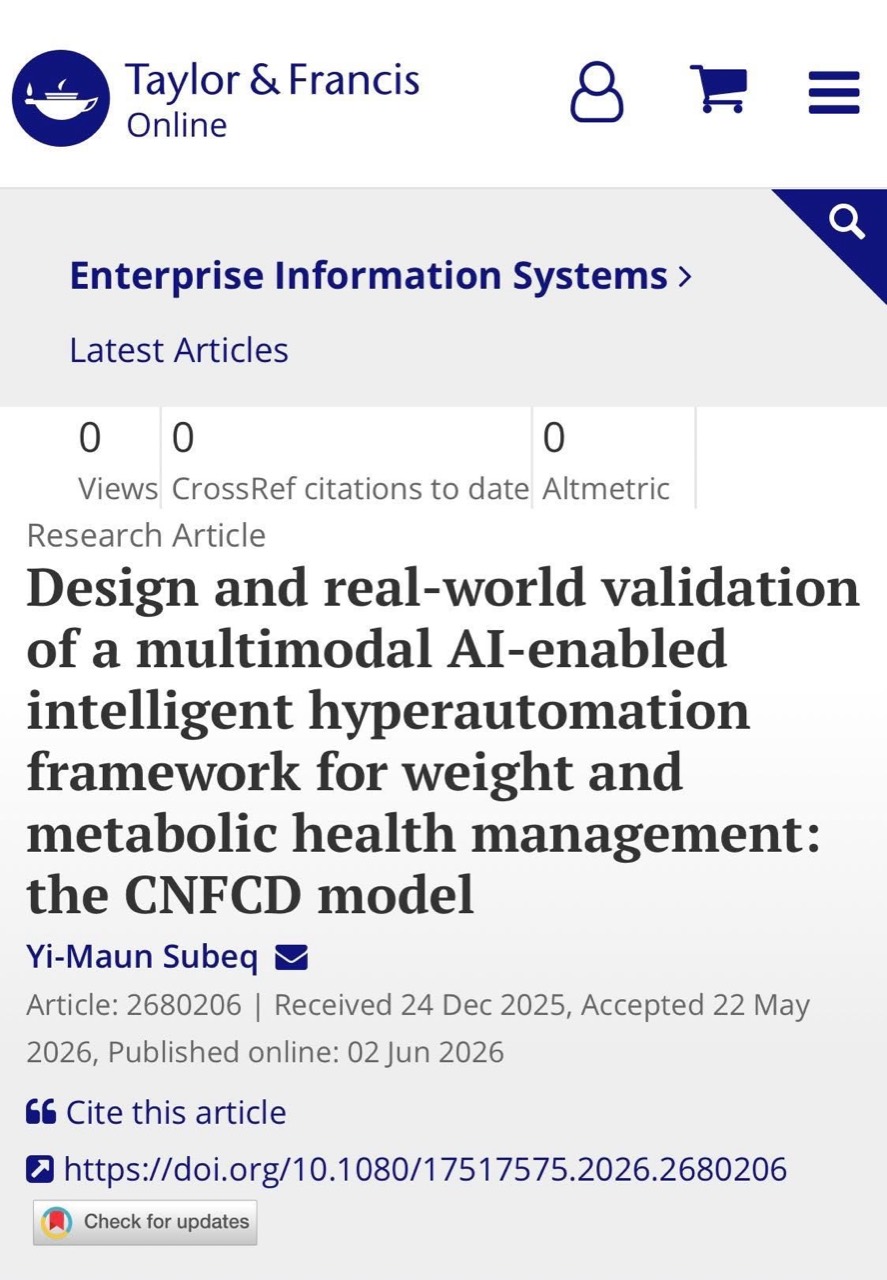
The CNFCD model was published online in Enterprise Information Systems on June 2, 2026.
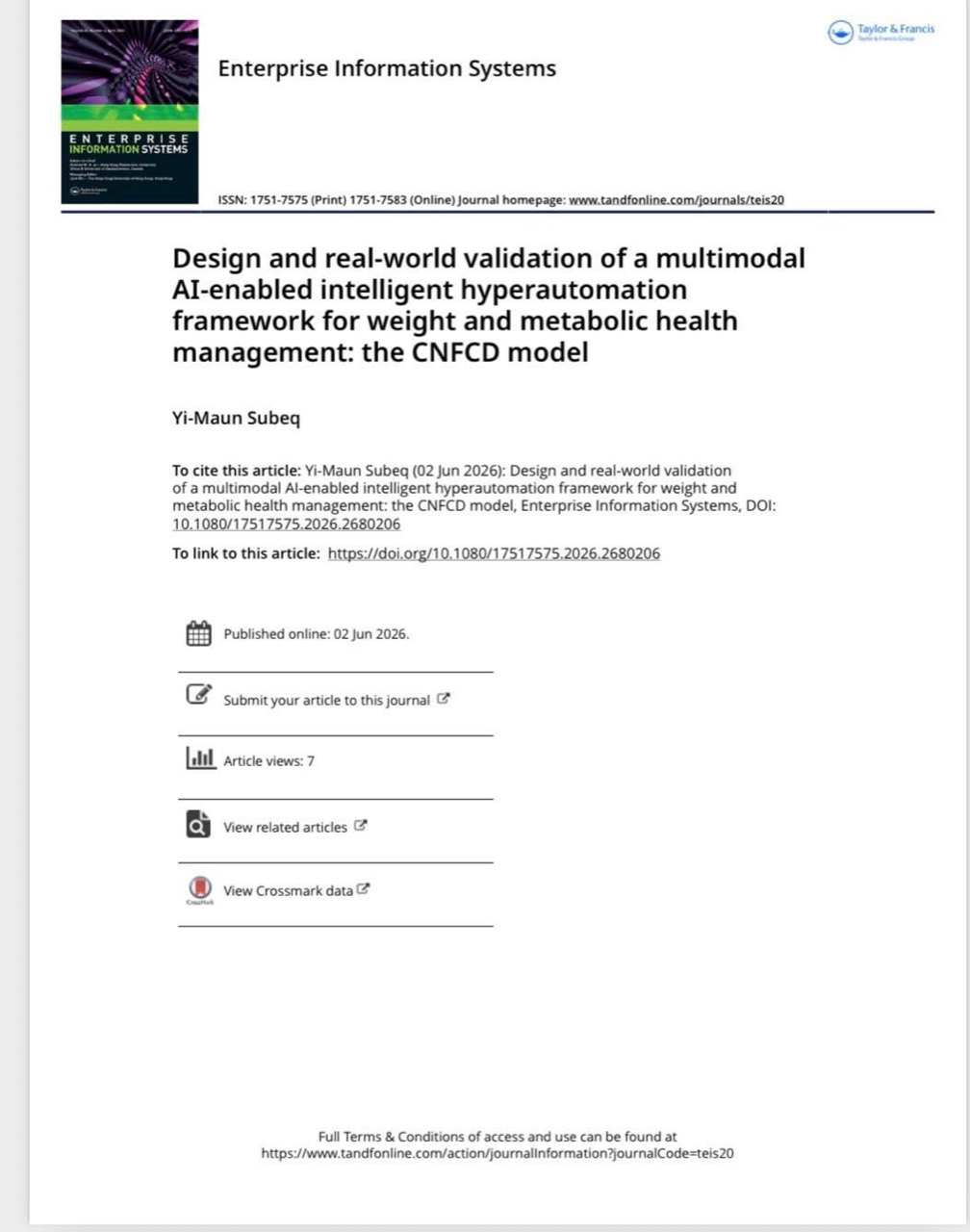
The CNFCD health program has been published in the international academic journal Enterprise Information Systems. The article, titled Design and real-world validation of a multimodal AI-enabled intelligent hyperautomation framework for weight and metabolic health management: the CNFCD model, was published online on June 2, 2026. The author is Yi-Maun Subeq, and the DOI is 10.1080/17517575.2026.2680206.
Why this study matters
This is not simply a weight-loss success story. The paper places the CNFCD model in the context of system design, real-world validation, AI-assisted decision support, human coaching, and metabolic health management.
According to the research context and program data provided by the team, CNFCD has accumulated more than 160,000 health data records, and 18,000 have completed a full transformation journey. That scale allows the model to be evaluated beyond isolated anecdotes: the key question is whether participants are only losing weight, or whether body composition and metabolic-health-related behaviors are also changing in a more sustainable direction.
Beyond weight loss: preserving the metabolic foundation
A common problem in conventional dieting is that weight loss may come with muscle loss. When muscle mass drops, basal metabolism and daily energy expenditure may be affected, making long-term maintenance harder.
One of the key points highlighted in the CNFCD data is that participants reduced fat while total muscle mass did not decline. The summarized result indicates an average increase of about 0.13 kg in muscle mass. This shifts the conversation away from short-term weight reduction and toward body composition, metabolic stability, and long-term execution.
This should not be read as a guaranteed outcome for every individual. The more defensible interpretation is that CNFCD does not rely only on calorie restriction. It combines nutrition structure, data feedback, coaching intervention, and behavior design into one operating system.
AI plus human coaching: detecting plateaus earlier
A core feature of CNFCD is the use of backend data to monitor changes. When the system detects a plateau or an execution issue, coaches can intervene earlier and help adjust food choices, structure, and behavior.
The point is not to replace human judgment with AI. The point is to use AI for monitoring and pattern detection, then allow human coaches to translate that information into practical next steps. For many people trying to lose fat, the hardest part is not motivation; it is knowing what to change when progress stalls.
Three habits identified by the data
The study context and backend observations point to three practical habits that appear important for execution and feedback.
- Measure weight and body fat consistently: measurement provides feedback and gives the system enough data to detect changes.
- Eat slowly and chew mindfully: eating pace affects satiety, food awareness, and decision quality.
- Eat enough green vegetables daily: vegetables provide fiber, food volume, and dietary stability.
How to interpret the publication
The publication of the CNFCD model in Enterprise Information Systems matters because it moves the discussion from marketing claims to a more structured research context. The practical message is not that one method guarantees the same result for everyone. The stronger message is that metabolic health management works better when data, coaching, nutrition structure, and behavior design are integrated.
For people facing repeated weight-loss plateaus or regain cycles, this research points to a clear direction: sustainable change is less about extreme restriction and more about building a system that can detect, respond, and adjust.
Source
Yi-Maun Subeq. Design and real-world validation of a multimodal AI-enabled intelligent hyperautomation framework for weight and metabolic health management: the CNFCD model. Enterprise Information Systems. Published online: 02 Jun 2026. DOI: 10.1080/17517575.2026.2680206.
Health note: This article is for health education and research communication only. It does not replace medical diagnosis or treatment. People with chronic disease, medication use, pregnancy, eating disorders, or special health conditions should consult a qualified healthcare professional.
ResetWith 顧問團隊
CNFCD® 個人化代謝健康系統 | 微康公司
本文由 ResetWith 顧問團隊根據科學文獻與超過 16 萬筆台灣真實個案數據撰寫。所有內容以 CNFCD® 方法論為基礎,供健康參考使用。
發布:2026年6月6日 最後更新:2026年10月20日
Recommended next reads
Author, Review, and Health Content Note
Publisher: ResetWith consulting team. Principal consultant: Pangpang / Sean Shih. Last updated: 2026-10-20.
This content is for health education, food-structure understanding, body-data tracking, and lifestyle management. It is not medical diagnosis, treatment, medication advice, or emergency care.
Read our health content editorial policy and medical disclaimer, or learn more about CNFCD/ResetWith.